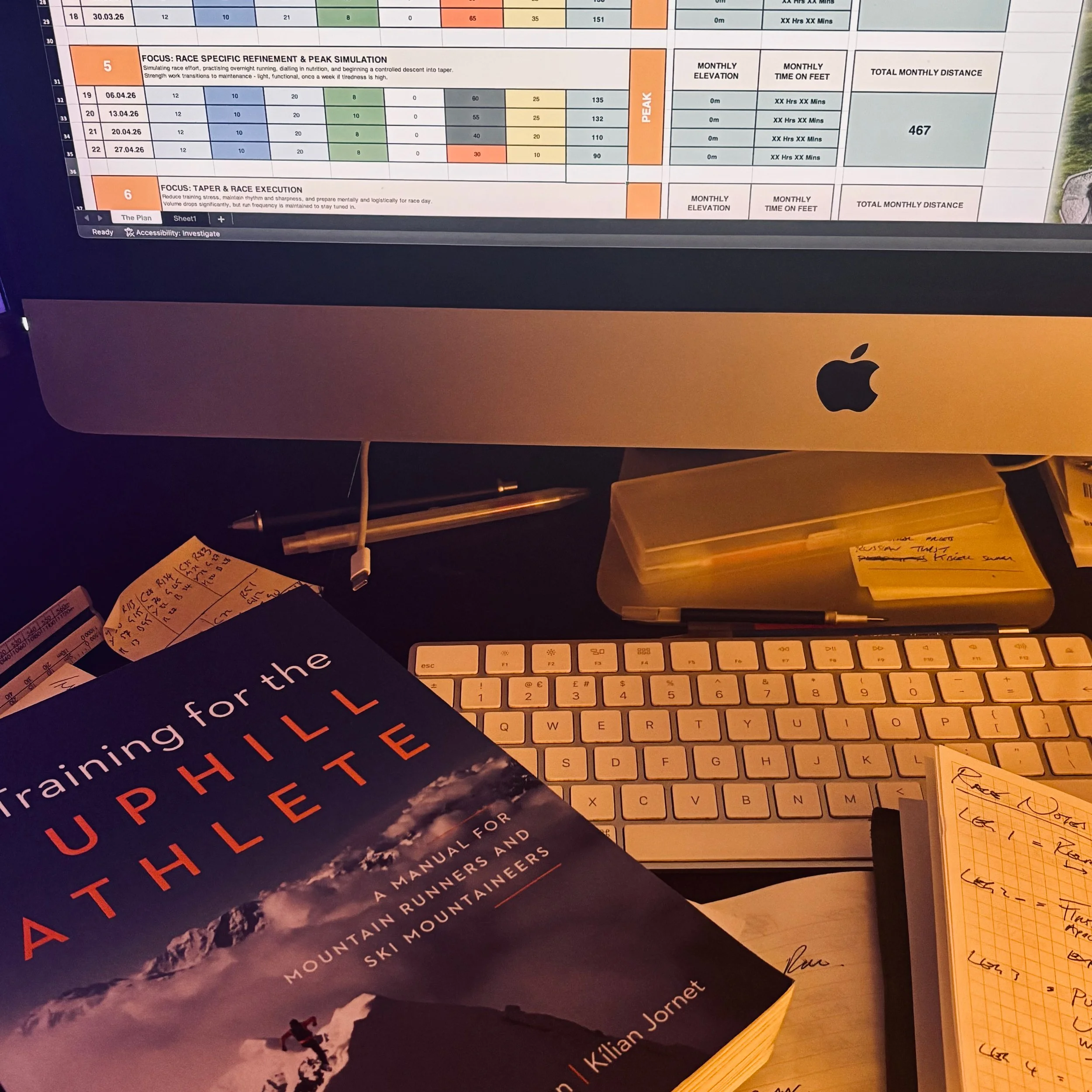
012: Planning the Plan

If there’s one thing I and Colonel Hannibal Smith have in common, it’s that we love a plan, particularly when they come together.
I’ve always leaned towards structure. There’s a comfort to be found in shaping your time into something intentional. I’m often asked how I set about making a running plan for the races I run, and I sometimes think those who ask must secretly regret it once I get going.
Lately, I’ve found myself needing such a plan more than ever, not just because I’ve decided on the first race of 2026. Over the last few weeks I’ve been thinking a lot more about the beginning, the process itself, the planning of the plan. How do you take something as big as preparing for a race and break it down into something you can live inside, week after week?
Before we go any further, I should be clear:
I am not a coach.
I don’t have the qualification, the certification, or the little card they give someone when they earn the title.
What I do have, though, is a system.
One that has carried me all the way to the finish line of a 100-mile ultramarathon, and through multiple ultras before that.
I guess that counts for something.
In my humble, unqualified opinion, the best way to get good at making training plans is to start by making a bad one. You build it, you run it, you watch it wobble in unexpected places, and you learn. You recognise what needs to be improved, and you make the next one better. Over time, your plans become less about perfection and more about wisdom, about knowing yourself and knowing what matters.
With all that in mind, here’s how I approach building a training plan for any event. Not as a coach or some fancy expert, but simply as a runner who has learned by doing, and occasionally by learning the hard way.
Step 1: Begin with the Event Itself
Before you can build a plan, you need to understand the thing you’re preparing for.
Each event has its own ecosystem of demands:
Distance: What must your body endure?
Terrain: Smooth road or technical trail? How much elevation?
Weather: What conditions are likely? Can you experience them in training?
Cutoffs / Time Goals: Do you have a target? Do the cutoffs demand a certain pace?
Logistics: How many aid stations are there? Will you use them or carry everything yourself? Does the route require navigation?
Preparing for an event begins with understanding the environment beyond the start line. Training without context is just movement. Purposeful training needs the context of the challenge.
Step 2: Understand the Athlete (That’s You)
This is the part most people skip, but it’s possibly the most important.
What is your current weekly mileage?
How quickly does fatigue build across weeks?
Can you handle back-to-back running days?
How prone are you to injury or niggles?
How much time do you realistically have to train?
What does life look like outside of running (work, stress, sleep)?
Where are you mentally right now?
You’re building a plan for the runner who’s reading this, not the future version you imagine, or the ideal one who never faces interruptions. Honesty forms the foundation for everything that follows.
Step 3: Define the Timeframe
Start with race day and work backwards.
Count the weeks you have available.
Identify the phases: Base, Build, Peak, Taper.
Note any non-negotiable life events.
Create space rather than squeezing time.
Good training isn’t rushed; it’s paced. It’s also flexible. Things will shift around. Discipline and patience allow you to hit your training targets even when life is unpredictable.
Step 4: Establish Your Training Pillars
These are the components that form the spine of an effective plan.
The Long Run: The weekly rehearsal for the resilience you’ll need on race day.
Easy Mileage: The quiet work that builds aerobic strength and durability.
Quality Sessions: Tempo runs, intervals, hill repeats - these are sharpening tools, not the main event.
Strength Training: The work that holds you together when the miles start to unravel you.
Recovery: Where the actual adaptation happens.
Cross-Training: Useful when done with intention rather than desperation.
Mindset Work: Journalling, visualising race-day situations, weekly reflections. The longer the race, the more essential this becomes.
A good training plan is an ongoing conversation between the stress your body is under and the recovery it needs. Both voices need to be heard.
Step 5: Build a Weekly Rhythm
This is where theory becomes something you can actually live.
For me, training for a 100-mile ultra, a sustainable week looks like:
One long run (usually on the same day of the week the race starts)
One quality session (though when the load gets high, I sometimes trade this for more easy miles)
Three or four easy runs
Two strength sessions (usually in the morning before work, with a run in the evening)
One rest day
The goal isn’t complexity; it’s repeatability. A plan you can follow consistently will always outperform the ideal plan you abandon by week three.
Step 6: Map Out Progression
A training plan should feel like a rising arc, not a straight line.
Increase your mileage gradually.
Add difficulty in manageable waves.
Use cutback or de-load weeks as intentional breathers.
Listen to your body, not your ego.
Adjust without guilt when life intervenes.
Adaptability is wisdom, not weakness. There’s no point hitting every session if it leaves you compromised rather than ready.
Step 7: Constantly Consider Your Mentality
Build in small check-in points:
What felt strong this week?
What felt heavy?
Where did doubt creep in?
What did you learn?
What surprised you?
These reflections turn repetition into growth. The more physical and mental self-awareness you develop, the more effectively you can fine-tune your training.
Step 8: Finalise the Plan
By now, your training plan should feel like a companion to your development, not a prescription promising a desirable end result.
A strong plan has:
A defined purpose
A clear weekly rhythm
Logical and gradual progression
Flexibility for the life you live around it
The best plan isn’t the fanciest, it’s the one you can follow week after week.
Once you’ve got it all pulled together, pause.
Consider what you’ve created.
Recognise the commitment it represents.
A training plan is an invitation to become the runner who will stand on the start line steady, prepared, and connected to the journey that brought you there. It won’t be perfect, no plan ever is. But if you build it honestly, follow it consistently, and adapt it wisely, it will take you exactly where you want to go.